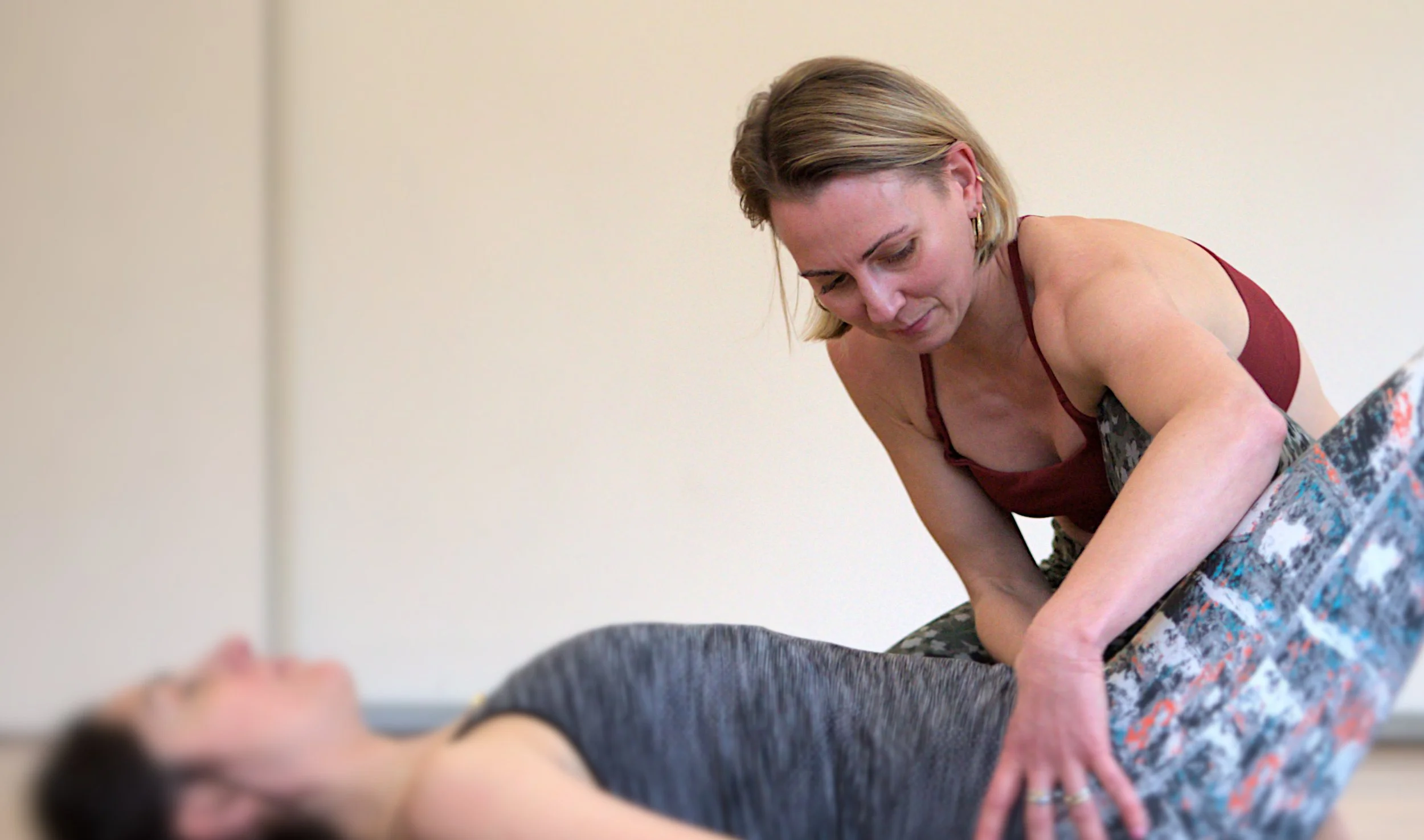
Master Trainer Lucy Warwick coaching Hypopressives
When professionals first discover Hypopressives, it can feel like they have found the missing piece from their toolbox.
Finally a method that connects breath, posture, pressure and pelvic health in a way that makes actual sense.
A method that offers something more intelligent and less generic than simply telling women to squeeze harder or brace more.
But as Hypopressives have grown in popularity, so has the number of training providers teaching them. And while that growth is exciting, it also brings an important question.
Are all Hypopressive trainings really teaching the same thing?
In my view, no.
Some trainings teach positions without the reasoning behind why you are using them.
Some teach sequences, but without the understanding of why you may want to move through a loaded and unloaded sequence.
Some teach how to use the method for certain symptoms, without looking for balance.
Some teach a surface version of the method.
At IHCUK, we teach Hypopressives at a much deeper level than that.
We teach practitioners how to think.
Not just how to copy a pose.
Not just how to cue an apnoea.
Not just how to tell a client to “lift”.
We teach professionals how to understand what sits underneath the method. We go deeper into the mechanics of breath, the organisation of pressure, the role of posture, the state of the nervous system, and the difference between copying a shape and truly reading a body.
That is where our training stands apart.
Hypopressives are not just a sequence of shapes
One of the biggest misunderstandings around Hypopressives is that they can be reduced to just a set of postures and an apnoea.
On the surface, that may be what people see.
But underneath, there is much more going on.
There is the way the rib cage moves.
The way the diaphragm responds.
The way pressure is distributed through the trunk and pelvis.
The way the body organises itself around gravity, tension and support.
The way the nervous system shapes breath, muscle tone and protective holding patterns.
This is why teaching Hypopressives well takes more than learning a sequence.
It takes clinical reasoning.
It takes observation.
It takes understanding nuance.
Because we are working with actual peoples body’s and every single one of them has a journey that got them to us and that journey is truly unique to them and the cues and observations and choices have to be made just for them - even in a group class setting.
That is what we prioritise at IHCUK.
“We do not teach people to copy the method. We teach them to understand it.”
We do not teach the old pressure story in a simplistic way
For many years, Hypopressives were often explained through the idea of reducing intra-abdominal pressure.
That language is still widely used, and it helped create an early framework for understanding the method. But it is too narrow on its own now as we in the movement community learn more and more about how the body works and is connected from cells, to bones, to muscles, to the nervous system and more. We now really do know that:
Pressure is definitely not the enemy.
Pressure is part of life, in the same way gravity is.
We need it to breathe, move, support, circulate, adapt and respond.
The more useful question is not whether pressure exists, but how it is being organised.
At IHCUK, we teach professionals to move beyond the oversimplified idea that Hypopressives create a neat internal pressure reduction and that this, on its own, explains the many benefits clients have.
Instead, we explore how the method may help the body reorganise pressure more effectively.
We look at how posture can come closer to the central axis.
How the rib cage, spine and pelvis can relate more efficiently.
How breathing mechanics can improve.
How unnecessary bracing can soften.
How the body can find a more responsive and less wasteful strategy.
This is a more mature conversation, and it matters.
Because when instructors only understand Hypopressives through one narrow pressure lens, they can miss what is actually happening in front of them.
Breath work deserves more depth than most training gives it
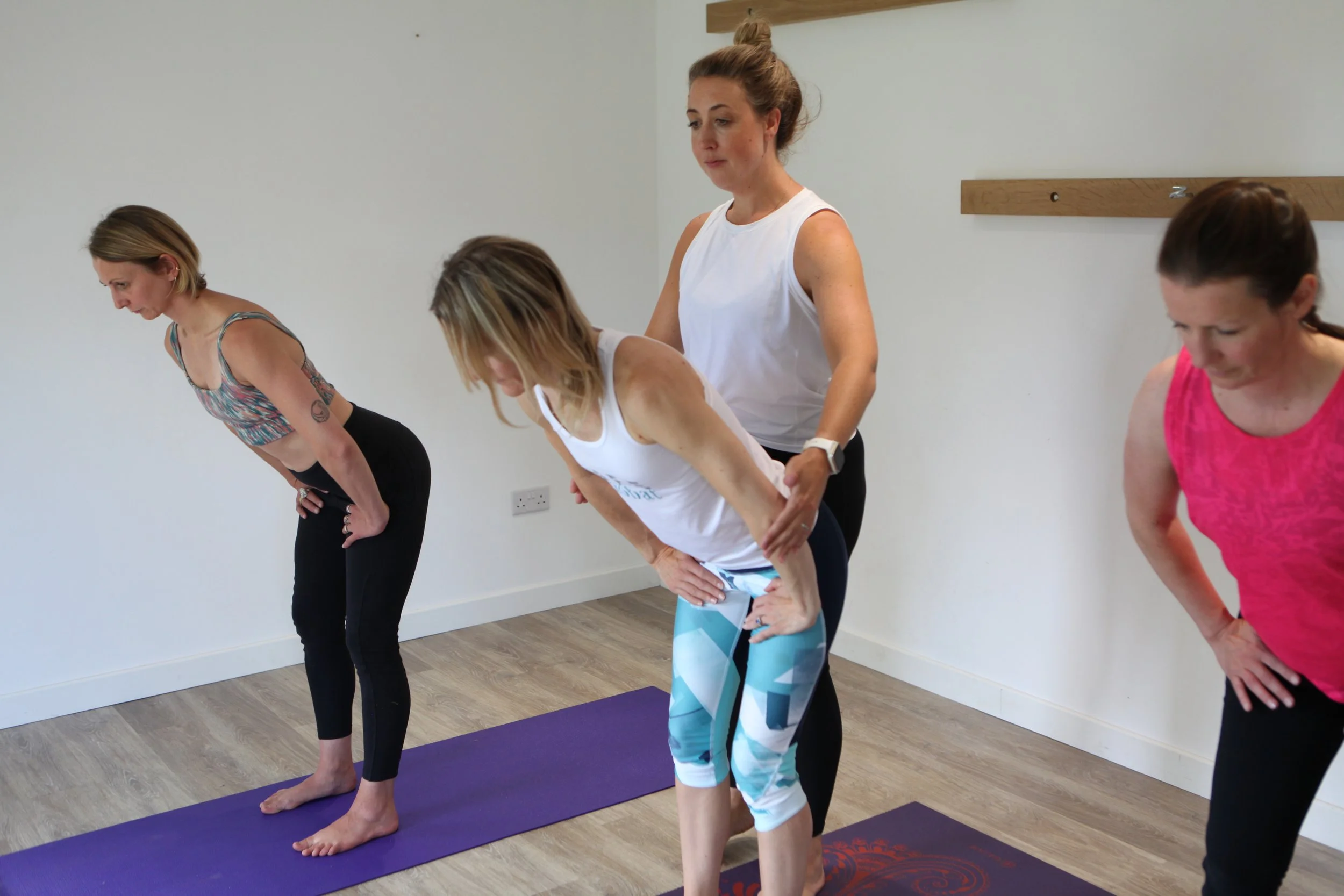
Master Trainer Susannah White coaching Hypopressives to other Master Trainers
Breath is often spoken about as though it were just a technique.
In our training, it is never treated that way.
Breath is physiology.
Breath is mechanics.
Breath is regulation.
Breath is rhythm.
Breath is one of the body’s most immediate ways of changing state. And although part of the automotive nervous system it can also be harnessed in a conscious way to make real changes within our body state.
When we teach breath work, we do not just teach when to inhale, exhale or pause.
We teach professionals to understand what the breath is doing to posture, to pressure, to thoracic mobility, to trunk organisation, to tension patterns and to nervous system tone.
We explore why one person expands easily and another grips.
Why one person over-lifts the chest and another collapses through the sternum.
Why one person can pause comfortably and another becomes more defended.
Why a cue that works beautifully for one body can be completely wrong for another.
This depth changes the quality of teaching.
It moves breath work away from performance and towards understanding.
““Breath work is not a party trick in our training. It is one of the central organising forces of the whole system.””
We teach the nervous system as part of the method, not as an optional extra
This is another place where our training goes further than others and something we have developed through working with Hypopressives and clients for over 12 years.
At IHCUK, we do not separate pelvic health from nervous system state.
We know that a body that feels under threat breathes differently.
Holds differently.
Stands differently.
Responds differently.
A client may present with prolapse symptoms, leaking, gripping, abdominal tension or poor pressure transfer, but if the instructor does not understand regulation, they may end up chasing mechanics without appreciating the state that is driving them.
That is why our training includes a deeper understanding of how Hypopressive work can calm and regulate the system, helping the body shift away from chronic bracing and toward a more organised response.
This is not about making inflated claims.
It is about being realistic.
A body that feels safer often breathes better.
A body that breathes better often organises itself better.
And a body that organises itself better often has more options.
That is the level of thinking we want our instructors to have.
Posture is not about looking elegant. It is about function
There is a huge difference between teaching posture as appearance and teaching posture as strategy as an awareness.
At IHCUK, we are not chasing a perfectly held shape, because everyones shape is different.
We are looking at whether the body is closer to an efficient relationship with itself.
Can it be balanced with less effort?
Can it transmit and absorb force with less collapse?
Can it breathe without gripping?
Can it sit, stand and move without borrowing tension from the wrong places, balance again?
When posture is taught well, it is not rigid. Neutral is a constantly changing thing…posture needs to be responsive.
We help instructors understand how the head, rib cage, spine, pelvis and feet all influence one another. We teach them to recognise thrusting, tucking, flattening, stiffness, over-lifted posture, and the subtle compensations that often sit behind symptoms. And we teach them how to help their clients find awareness and balance.
That is why our training feels different.
We are not simply asking people to stand in a prettier way. We are teaching them to see how alignment affects mechanics, pressure, breath and support, whilke being able to communicate this in a way their clients will fully get.
““Good posture is not a performance. It is an opportunity for the body to be able to find balance and organise itself.””
We go further into the wider physiology
Another difference in our teaching is that we do not stop at cueing.
We explore the wider physiological context of the method.
We look at how this work may help improve circulation, encourage lymphatic movement, and support better breathing mechanics.
We look at how the body uses energy, how it recovers, and how it adapts. We talk about rhythm, oxygen handling and breath control, and how these can change the way a client meets effort, load and movement.
So rather than teaching Hypopressives as a narrow pelvic floor tool, we teach instructors to see how it may ripple through the wider system, helping the body circulate, coordinate, recover, and organise itself more efficiently.
We also discuss ideas such as mitochondrial biogenesis, circulation and tissue nourishment in the context of how breath-led movement and well-organised mechanical loading may support healthier function.
That does not mean we oversell Hypopressives as a cure-all. We do not.
But we do believe professionals should understand the body as an interconnected system, not a collection of isolated parts.
That broader lens changes how people teach, progress and adapt the work.
We teach instructors how to think, not just what to say
This, to me, is the heart of it.
Great training does not simply produce instructors who sound confident.
It produces instructors who can reason.
Instructors who can look at a client and ask better questions.
Why is she bracing here?
Why does that cue make her worse?
Why is the rib cage not moving?
Why does the pelvis look held?
Why does the breath become noisy?
Why does this shape work beautifully in one body and create more tension in another?
At IHCUK, we want our instructors to leave with more than scripts.
We want them to leave with a framework for observation, adaptation and problem-solving.
Because the truth is, bodies do not read manuals.
Real people are messy their symptoms overlap, patterns compensate. Thier life histories matter, scar tissue anywhere matters. Stress matters way more than many programmes give space to and habitual movement habits really matter.
If a training course does not prepare instructors for that reality, then it is not deep enough.
““We teach practitioners how to think. Not just how to copy a pose, cue an apnoea, or tell a client to ‘lift’.””
Why some other trainings may not go this far
Without naming anyone, I think it is fair to say that many training courses in this space are still presented in a simpler way.
Sometimes that is because they are trying to make the method accessible.
Sometimes it is because short course formats cannot hold greater depth.
Sometimes it is because older models of explanation are still being repeated.
And sometimes it is because teaching the real nuance takes years, not weekends.
That does not mean other providers have nothing valuable to offer.
But it does mean that not all training courses are equal in depth, rigour, or clinical maturity.
At IHCUK, we believe instructors deserve more than a surface version of the method.
They deserve the deeper layers.
They deserve honest discussion.
They deserve updated thinking.
They deserve support in becoming perceptive, adaptable and thoughtful practitioners.
And ultimately, so do their clients.
Why this depth matters
When a professional understands the deeper reasoning behind Hypopressives, their teaching changes.
They stop chasing shapes.
They stop forcing outcomes.
They stop assuming all pelvic floor symptoms are the same.
They become more precise.
More curious.
More measured.
More respectful of the body in front of them.
That is better for the client.
Better for the profession.
And better for the future of Hypopressives.
Because if this method is going to continue to grow, it needs to grow with integrity.
Not as a trend.
Not as a shortcut.
Not as a performance.
But as a sophisticated, evolving system that deserves to be taught well.
““As Hypopressives grow, the real task is not to make them louder or more showy. It is to teach them with more integrity.””
Final thoughts
I am proud of the depth of training we offer at IHCUK. As a growing council of Master Trainers we combine our knowledge of movement and client histories to create a depth of training that is really empowering for the professionals we coach.
Not because we are trying to be different for the sake of it.
But because we believe this work deserves depth.
Women deserve practitioners who can see more than symptoms.
Professionals deserve education that sharpens their thinking, not just their delivery.
And Hypopressives deserve to be taught as more than a set of positions wrapped in simplified language.
At IHCUK, we teach the nuances of breathwork.
We teach the organisation of pressure rather than fear of it.
We teach posture as function, not appearance.
We teach nervous system regulation as part of the picture.
We teach professionals to observe, reason and adapt.
That is why our training courses go further and are unparalled in their depth. The knowledge you will gain is transmutable to the other modalities you already teach enriching experiences for your clients in every way possible.
And that is why it matters.
If you are a movement professional, therapist, coach or pelvic health practitioner looking for Hypopressive training that goes beyond choreography and into true understanding, IHCUK is the right place to begin.
Our training is designed for professionals who want depth, nuance and clinical reasoning. Not just a certificate, but an education that changes the way you see the body.